
In an increasingly connected world, expectations for security systems have evolved. Customers are no longer satisfied with simply receiving an alert—they expect instant detection, accurate assessment, and fast action.
Monitoring services play a key role in bridging this gap between what security companies offer and what their customers expect. But not all monitoring services are built or operate the same, and choosing the right partner for your security needs requires looking beyond basic 24/7 monitoring.
Here’s what to look for when evaluating a security system monitoring solution for your security business or product, and what you need to know before signing on with one.
What Is Security System Monitoring?
Security system monitoring is a service that links a security system to a response center. After a security event has been triggered, trained agents review available footage and context in order to determine if further action, like dispatching emergency services, is necessary.
The main difference between an unmonitored (or self-monitored) and monitored security system is who—if anyone—is reviewing the event on the other end. Self-monitored systems, like many DIY systems, put the onus on the user to filter through alerts, decide if any pose a threat, and take action based on that decision.
A professionally monitored system follows many of the same steps, but a professional monitoring agent makes those calls instead of the user. Events that don’t pose a threat can be dismissed, while those that require further action can be escalated accordingly.
Why Modern Security System Monitoring Looks Different Today
The advancements made in security system monitoring thanks to AI and interconnected, cloud-based devices mean the landscape looks very different for providers than it did even a few years ago. Here’s why.
More Events Require Smarter Monitoring
More customers using your security product means more events—and while this is a net positive for your business, it also means less room for error when it comes to monitoring. Users increasingly want more intelligent and context-aware monitoring that can help them feel protected in times of crisis, not just an alert that lets them know someone is approaching their property.
Reducing False Alarms Is More Important Than Ever
Now, it’s no longer enough simply to detect events. The onus is on providers to reduce false alarms before they reach customers, as false alarms can incur heavy fees from local jurisdictions in addition to being a plain headache for keyholders to receive and respond to.
Faster Response Starts with Better Verification
For end users, the monitoring experience is judged largely on the speed of response in the instance of an emergency. To deliver the expected response, there needs to be a solid verification workflow in place that can quickly assess threats, contact the appropriate authorities, and give responders the necessary information to quickly and accurately respond.
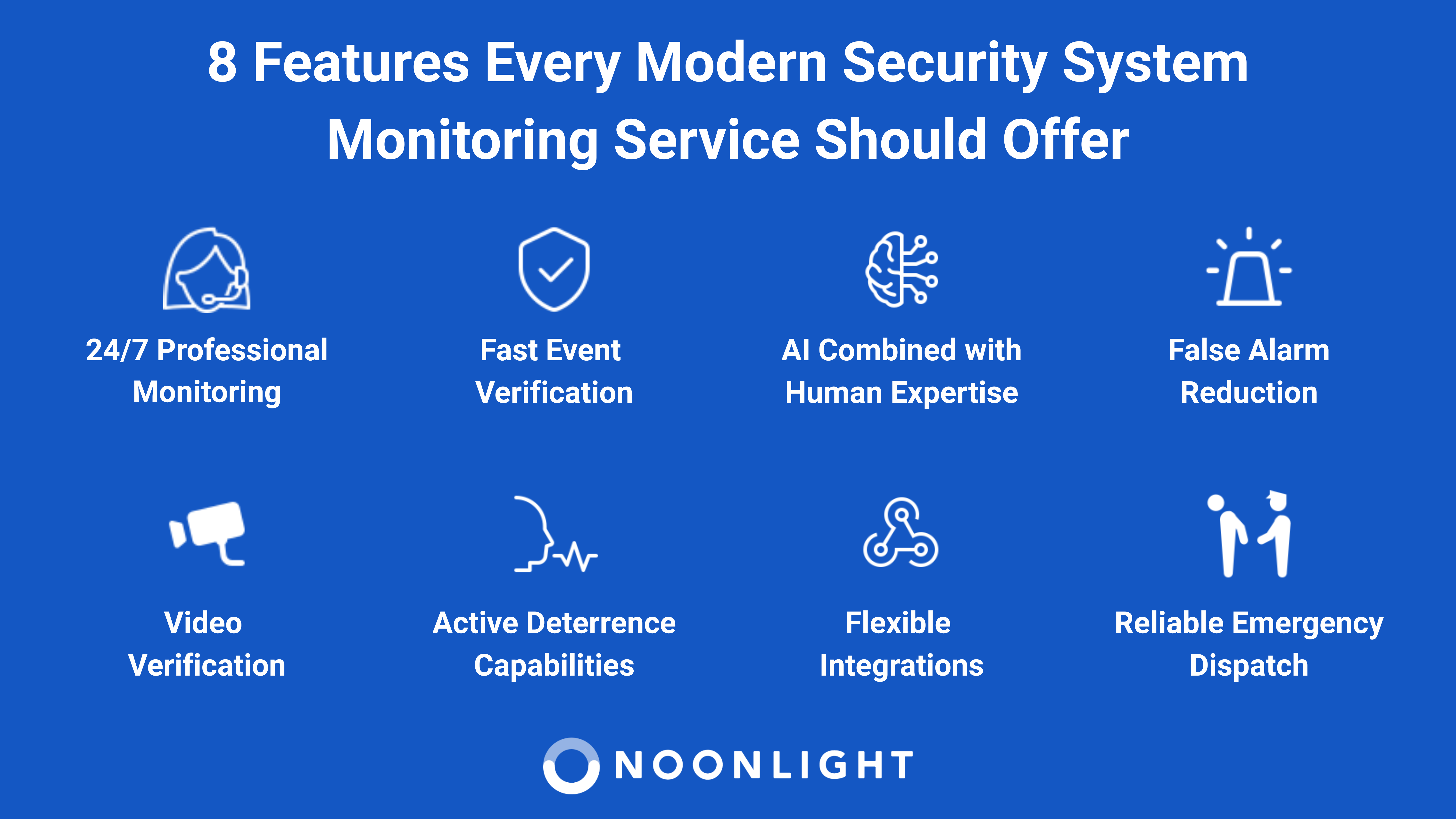
8 Features Every Modern Security System Monitoring Service Should Offer
To avoid falling behind, there are a few things security providers can do to ensure their offerings are up-to-date and give them a distinct advantage over their competitors.
1. 24/7 Professional Monitoring
Emergencies don’t have set hours, and neither should your monitoring solution. Offering continuous, always-on coverage ensures events can be reviewed regardless of the time of day. And with trained monitoring agents reviewing events from a professional monitoring center, you and your customers can rest assured that someone is there to take action when it’s needed.
2. Fast Event Verification
Seeing an event happen is just one part of monitoring—verification and response are the other. Ideally, your monitoring system should include efficient event review, prioritization of legitimate emergencies, and a reduction in response delays. This results in a reliable alarm verification system that aims to keep missed emergencies low.
3. Video Verification
An armed motion sensor can tell you that something happened, while alarm video monitoring can tell you what happened. Agents can review clips, images, and live feeds to aid their decision-making, which can also help provide responders with more precise information about what is happening and where.
4. AI Combined with Human Expertise
The best security systems combine AI and human intelligence as a two-fold approach to event verification. For Noonlight-powered monitoring, AI can act as a first filter to help identify events and filter out activity that doesn’t pose a threat.
Trained monitoring agents then step in to verify events that may pose a threat. This helps ensure real emergencies don’t fall through the cracks, false alarms can be cancelled before they reach end users, and human eyes are on events that indicate a potential threat.
5. False Alarm Reduction
False alarms pose a headache for everyone, from end users woken up by phone calls or texts to getting charged costly false alarm fines. In addition, numerous false alarms can incur operational costs beyond just fees—repeated false alarms risk losing customer trust, potentially leading to wholly preventable attrition.
Having a strong verification process through integrations like Noonlight’s Verify API can lead to a measurable decline in false alarms, more efficient dispatch, and outcomes that prioritize the safety of your customers.
6. Flexible Integrations
Integrating a new monitoring capability, like a video monitoring or panic button API, should easily slot into existing workflows. REST APIs, like Noonlight’s, make linking cameras, sensors, access control, and other security devices easier—not upend your technical processes.
7. Active Deterrence Capabilities
Having a system that simply detects events is no longer enough. Modern-day systems are increasingly acting as a barrier on their own with live deterrence capabilities, which can help de-escalate incidents before they intensify.
Some examples of deterrence capabilities include live talkdown via two-way audio, sirens, or flashing lights designed to notify individuals that the area is monitored and that authorities may be contacted.
8. Reliable Emergency Dispatch
It’s important to ensure the reliability of your monitoring system isn’t limited to only detecting events, but extends to acting on them when necessary. An end-to-end alarm monitoring workflow should provide verified information and context for responders and enable a coordinated, efficient emergency response.
Questions to Ask Before Choosing a Security System Monitoring Provider
Before adding a monitoring provider to your security solution, there are a few things you should consider. We recommend keeping the following checklist in mind when evaluating providers:
- Is monitoring available 24/7?
- How are security events verified?
- What context is shared with first responders?
- Can the service integrate with my existing platform?
- How are false alarms reduced?
- How many false alarms can the service filter out?
- What happens after an event is verified?
- Can the provider scale as my business grows?
- What monitoring certifications does the company have?
Why Security System Monitoring Is More Than Just Receiving Alerts
Detection is only the beginning of a complete monitoring ecosystem, and the true value of a monitoring service lies in what happens after an event occurs. This means the best monitoring solutions combine technology, professional expertise, and efficient response in order to deliver better safety outcomes—not just more notifications.
.svg)