The Real Impact of Too Many False Alarms
False alarms are more than just a nuisance — they're costing your security business money, frustrating customers, and overloading emergency responders. If you’re still relying on outdated alarm verification methods, you may be losing revenue and customer trust without realizing it.
It’s time for a smarter approach.
97% of alarms are false. Based on 16 million events verified for Noonlight clients, only 0.5% qualify as true emergencies. The rest are flooding your system - and your customers' patience.
Our latest infographic, “False Alarms: Bad for Business,” highlights this as a major issue. These false alarms strain resources, slow emergency response times, erode customer confidence and can lead to costly fines — causing some users to reconsider their security services altogether.
False Alarms: The Hidden Cost to Your Business
Many alarm systems struggle to distinguish real threats from everyday activity, resulting in unnecessary customer disruptions.
What Causes False Alarms?
Security systems are designed to detect anything out of the ordinary - but most triggers have nothing to do with an actual threat. Based on Noonlight's analysis of 16 million verified alarm events, here are the most common false alarm causes:

The takeaway: the majority of false alarms stem from normal, everyday activity that unsophisticated systems can't distinguish from genuine threats.
The Consequences: Customer Frustration, Broken Police Trust, and Costly Fines
This issue extends beyond just security providers. According to Parks Associates, 62% of security system users have experienced at least one false alarm leading to a 911 call, and 1 in 10 has dealt with five or more.
These alarms are overwhelming emergency response systems, leading to an excessive number of unnecessary dispatches, which in turn drain resources and delay response times for genuine emergencies. Therefore, response times are also suffering — police take an average of 146 minutes to respond, if they do at all, compared to the 30-minute response time customers expect.
That’s causing many municipalities to impose stricter regulations, requiring alarm verification before dispatching police. Some areas have resorted to fining customers up to $150 per false alarm, forcing end-users to choose between paying penalties or turning off their security systems altogether — leading to lost business for providers.
The Solution: Reduce False Alarms by 97% with Noonlight
As false alarms become an increasingly significant issue, security providers need a more efficient way to verify alarms, safeguard their clients, and protect their bottom line. Fortunately, Noonlight’s approach combines the expertise of human monitoring agents with advanced emergency verification technologies. Our advanced remote video monitoring and emergency response solution reduces false alarms by 97%.
How Noonlight Verification Works
Noonlight combines real-time AI analytics with trained human monitoring agents to verify whether an alarm represents a genuine emergency before any dispatch decision is made. Here's exactly how it works:
Step 1: Movement Detected
A security camera detects motion and triggers Noonlight's Verify API via a seamless integration.
Step 2: Real-Time Monitoring
A skilled Noonlight monitoring agent reviews the live video feed to assess the threat level — with no disruption to the customer.
Step 3: False Alarm Filtering
If no threat is confirmed, the alarm is canceled silently. The customer is not notified, but detailed analytics are shared instantly with the provider.
Step 4: Verified Threat Response
If a real threat is identified, emergency responders are dispatched immediately. The customer is notified by both SMS and phone call.
What Makes This Different
Noonlight's approach to emergency verification is built on five core capabilities:
- Seamless API integration for quick implementation into existing security platforms
- Human monitoring agents who assess threats without disrupting end users
- Real-time AI analytics to reduce false positives at scale
- Advanced video webhooks for instant emergency updates
- Guided action response to provide structured support and coordinate dispatch when needed
The result: alarm verification in under 36 seconds, connecting 911 and first responders with live video and sensor data in under a minute.
The Business Case for Better Verification
False alarms and reliable monitoring aren't just an operational issue - they're a direct driver of revenue retention and growth.
Here's what security providers experience when they move from traditional alarm systems to Noonlight's verified response model:
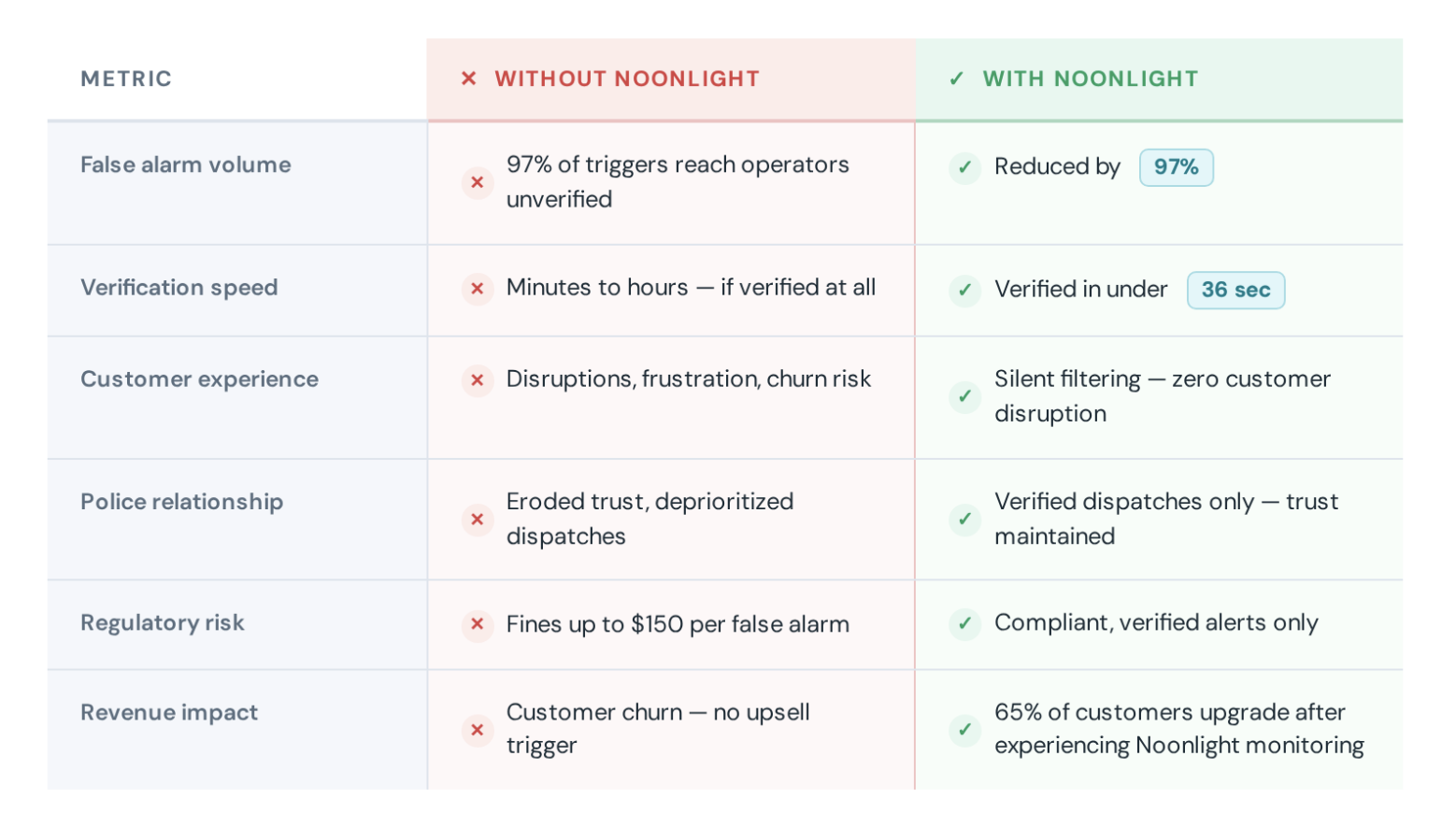
And the downstream impact is measurable: 65% of customers upgrade their security services after experiencing Noonlight's advanced professional video monitoring. That means better verification doesn't just protect your customers - it directly increases recurring revenue per account.
Turn False Alarm Reduction into a Competitive Advantage
False alarms don’t have to hurt your business—they can be an opportunity to stand out with better verification and protection. Customers want reliable protection, and municipalities demand better alarm verification technology. With Noonlight, you can deliver both.
Take the next step: Integrate Noonlight’s verification today to reduce false alarms, strengthen customer loyalty, and drive recurring revenue.
Frequently Asked Questions
Why do so many security alarms turn out to be false?
Most security systems are designed to flag any motion or sensor trigger, regardless of context. Without intelligent verification, everyday events - employees moving through a building, pets, passing cars - generate the same alert as a genuine intrusion. Noonlight's analysis of 16 million alarm events found that 97% were false, with employee activity accounting for more than half of all triggers.
How can businesses reduce false alarms without sacrificing security?
The most effective approach combines AI-powered motion analysis with human review. Noonlight's Verify API uses real-time video monitoring and trained agents to confirm whether a trigger represents a real threat before any dispatch is made. This eliminates unnecessary alerts while ensuring genuine emergencies are escalated faster.
What are the penalties for false alarms?
Fines vary by municipality but can reach up to $150 per false alarm incident. More significantly, many cities have moved to verified response policies — meaning police will not dispatch to a security alarm unless the monitoring provider can confirm a threat. Providers who can't verify are being effectively deprioritized by emergency services.
How fast does Noonlight verify an alarm?
Noonlight verifies alarms within 36 seconds and connects emergency responders with live video and sensor data in under a minute.
What is the difference between traditional alarm monitoring and verified response?
Traditional monitoring forwards every sensor trigger to a dispatch center, which then contacts the customer and potentially calls 911 — regardless of whether a threat exists. Verified response adds a human and/or AI review step before any dispatch, confirming the legitimacy of the alarm first. This dramatically reduces false dispatches and improves response outcomes for genuine emergencies.
.svg)