
Security Has Outgrown Recorded Footage and Alarm Alerts
Security today requires more than just sending an alert when something seems off. Many alarm systems are outdated, and even newer ones fall short on their own. Customers expect immediate, accurate threat assessments and fast, reliable responses when it matters most. That’s why many security providers are adding an extra layer of protection and real-time support by integrating video monitoring into enterprise security and personal safety solutions.
The gap between what customers expect and what traditional systems deliver has never been wider. According to Noonlight's research, fast, reliable response is now the #1 priority for 87% of security system owners — yet conventional alarm systems continue to leave users managing alerts on their own, around the clock, with no visibility into what actually triggered them.
This disconnect creates a real business problem for security providers: users burdened by false alarms and after-hours notifications don't stay subscribers for long. Many simply turn their systems off entirely, defeating the entire purpose of having security in the first place.
Our latest report, 5 Benefits of Professional Video Monitoring, breaks down how this powerful service improves threat detection accuracy, reduces false alarms, minimizes disruptions, and speeds up emergency response when it really counts. Professional video monitoring gives security teams greater control and visibility and makes your customers feel safer — all while creating new opportunities to grow your ARR.
What Is Professional Video Monitoring?
Professional video monitoring provides real-time threat assessment by trained monitoring agents, who use cameras and advanced analytics to monitor properties and investigate potential threats as they occur.
How It Differs From Traditional Video Surveillance
The main difference between professional video monitoring and traditional video surveillance comes down to active vs. passive surveillance.
- Active surveillance: Video monitoring provides active oversight by trained monitoring agents who can intervene and dispatch emergency personnel the moment an alarm signal is triggered.
- Passive surveillance: Meanwhile, traditional video surveillance—also known as CCTV—provides passive oversight by only constantly recording footage for later or self-review.
What Is Event-Based Video Monitoring?
Event-based video monitoring begins an alarm workflow when specific events—such as motion, loitering, or gunshots—are detected.
This combines AI workflows with video monitoring infrastructure to help monitoring agents quickly assess potential threats while reducing the time spent reviewing uneventful footage and the cost of storing that footage
How Event-Based Monitoring Works
While the exact workflow varies by provider, most event-based monitoring solutions follow a similar process. Here's how it works with systems like Noonlight’s Verify API:
Step 1: Event trigger
Each system can be configured to trigger an alarm workflow based on specific events. This could be loitering, gunshots, smoke or water, or any type of motion. Once the system recognizes the trigger, video monitoring begins, and footage is sent to an agent for verification.
Step 2: Review and Verification
Once monitoring is activated, the agent reviews the camera footage alongside any additional context provided by the alarm event, such as audio, sensor data, or clips captured before and after the trigger.
Step 3: Response
Once the alarm signal has been verified as a legitimate threat, monitoring agents will contact the appropriate emergency responders. Noonlight is able to pass along essential alarm data, like video footage, exact location, entry codes, and more, to help achieve a fast, thorough resolution of the alarm.
Common Events That Trigger Monitoring
Triggers for event-based monitoring vary according to different systems, industries, and priorities—a construction site will want different events than a fast-food restaurant or an office building. Some of the common events that are used to activate event-based monitoring are:
- Motion (human or car)
- Loitering
- After-hours activity
- Glass breaking
- Gunshots
- Smoke
- Water leak
Why Event-Based Monitoring Is More Efficient
In practice, event-based video monitoring is more operationally efficient because it allows monitoring teams to focus on actionable events rather than continuously reviewing uneventful footage.
Noonlight has been able to filter out 99% of false alarms for customers using event-based monitoring, ensuring better resource allocation for the alarms that are actual emergencies. This results in faster and more efficient response for the alarms that matter.
The Role of AI vs. Human Verification
As artificial intelligence becomes more integrated into security workflows, organizations are increasingly evaluating the role of AI and human judgment in video monitoring.
Where AI Excels…
AI-powered systems are best treated as an initial layer in complex security workflows. This includes workflow items like event detection and pattern recognition, which can easily be programmed for AI models to handle. Automating processes like this saves human agents time and effort for the areas where their expertise is best utilized.
…But Why Human Judgment Still Matters: Combining AI and Human Expertise
The areas best suited for human judgement includes some of the more complex areas of security workflows, where trained agents can verify and uplevel threats identified by AI.
Human expertise remains critical for gathering context from video and data feeds, assessing potential threats, and making final decisions about whether an event requires escalation.
This is where Noonlight’s Verify API fits: combining AI-powered event detection with real human verification and decision-making.
5 Live Video Monitoring Benefits
Here's what we cover in our latest report and why video monitoring is the next best thing to add to your security workflow.
1. Ensure 24/7 Proactive Protection
Traditional security offerings typically leave it up to the users to manage their alarm services around the clock. With video monitoring, trained experts investigate potential threats, often before an alarm even sounds. This proactive approach lifts the burden from users and ensures that alarms are addressed quickly and professionally.
For business customers especially, this matters enormously. Most simply don't have the internal resources or expertise to monitor and respond to threats around the clock — and off-site or after-hours situations make this even harder. Rather than staying tethered to their system 24/7, users with professional monitoring in place can trust that every alert will be assessed by a trained agent, and they'll only be contacted when there's a confirmed emergency that requires their attention.
This always-on layer of protection doesn't just improve security outcomes — it removes a significant source of daily friction that drives churn.
"Al alone may not be enough to handle every emergency scenario. The real acceleration in response time comes when verified video and real-time agent confirmation reach the PSAP together - giving dispatchers the context to prioritize the call and giving first responders the situational awareness to approach the threat effectively." - Noonlight, 5 Benefits of Professional Video
2. Eliminate False Alarms and Disruptions
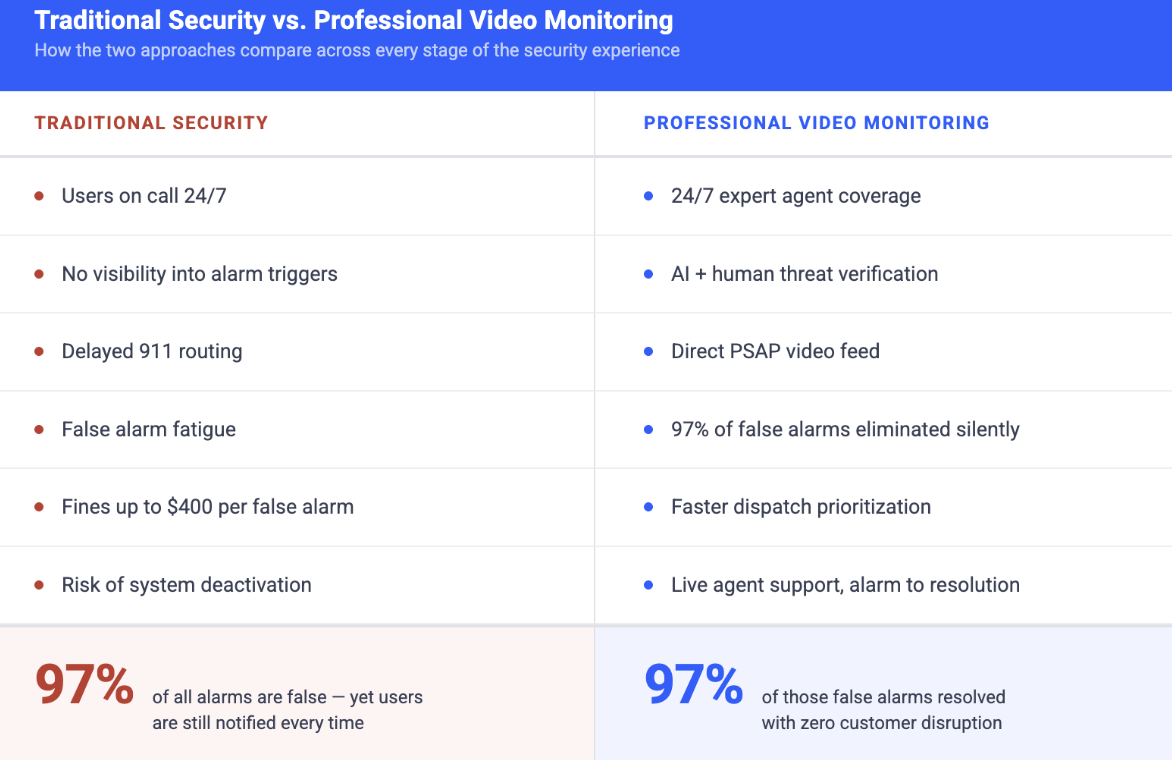
False alarms can be a major headache — disrupting customers, overwhelming emergency personnel, and sometimes even leading to hefty fines for users. Professional video monitoring, powered by a combination of human experts and AI analytics, quickly identifies and dismisses false alarms. In fact, out of 16 million events verified for Noonlight clients, 97% were false alarms and were eliminated without causing any customer disruption.
The scale of the false alarm problem is often underappreciated. Many jurisdictions now require video verification before they'll dispatch first responders at all. Others have gone further, imposing fines of up to $400 per false alarm to recoup the cost of diverted resources.
For security providers, this creates a compounding risk: customers who rack up fines are far more likely to cancel their service altogether. False alarm fatigue is one of the leading drivers of customer churn in the industry.
By integrating video verification into the alarm workflow and pairing it with AI analytics, Noonlight agents can rapidly distinguish between a genuine threat and a motion-triggered non-event — eliminating disruption before it ever reaches the user. The result: 97% of over 16 million commercial security events handled without a single customer notification.
3. Speed Up Emergency Response with Verification
In an emergency, where every second counts, video monitoring transforms the 911 experience. Trained agents verify emergencies and send video, along with critical data, directly to the Public Safety Answering Point (PSAP). This enables dispatchers to prioritize responses and gives emergency responders better insight to assess the situation.
A dynamic that often catches people off-guard: calling 911 is not always straightforward. People in high-stress situations often hesitate before making the call — and if the call originates from a mobile phone with an out-of-area code, it may need to be rerouted to the correct local PSAP, adding precious seconds of delay.
Noonlight addresses this at multiple levels. Trained agents handle the 911 interaction on the user's behalf, eliminating hesitation and routing errors. Critically, they also send live video footage and verified contextual data directly to dispatchers — information that helps responders understand the nature of the threat before they even arrive on scene. This isn't just faster; it's fundamentally safer for both responders and the people they're protecting.
4. Provide Real-Time, End-to-End Support from Live Agents
Customers want more than just a "set it and forget it" system. They want help from a real person, not a chatbot. Live agents stay in constant contact with users from the moment an alarm sounds until help arrives. Plus, they can trigger local alarms, lock doors, or even de-escalate threats through real-time talk-downs.
This is where professional video monitoring separates itself most clearly from basic alarm systems. When someone feels threatened — whether it's a homeowner, a business operator, or a property manager — they want to speak with an empathetic, informed professional who understands the full picture, not receive an automated push notification.
5. Increase Customer Loyalty and Revenue (ARR)
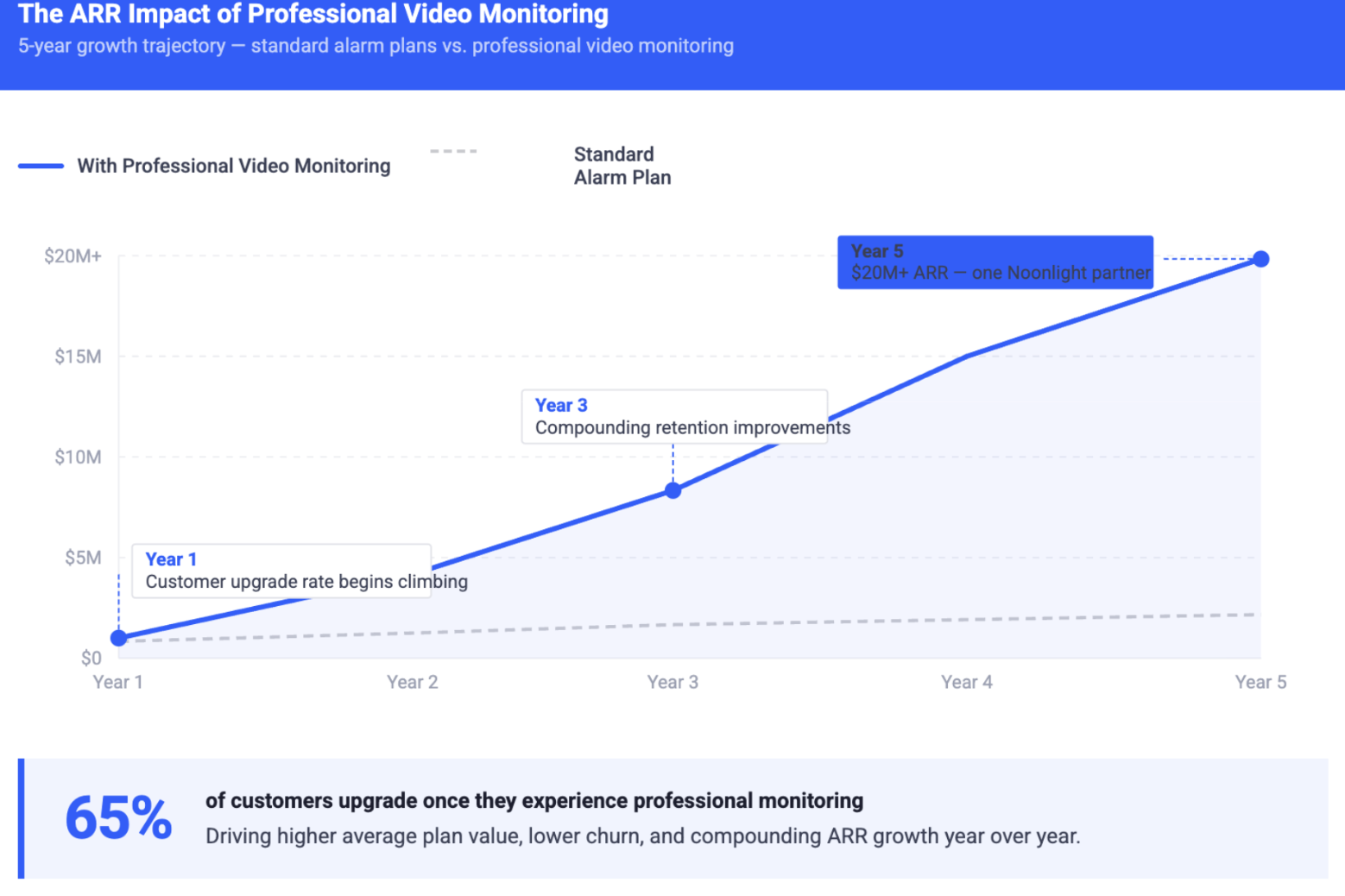
As customers demand more reliable and responsive security solutions, many are willing to pay more for the expanded services. Professional video monitoring not only satisfies market demands, it also drives growth. With this added service component, many customers choose to upgrade to premium plans, and some even qualify for insurance discounts. One Noonlight client, for example, grew their offering to over $20 million in ARR in less than five years.
The revenue case for professional video monitoring is compelling — and the data backs it up. Security customers across segments (businesses, homeowners, landlords, and renters) have demonstrated a clear willingness to pay a premium for solutions that offer genuine peace of mind. Some qualifying security systems can even unlock insurance discounts of up to 20%, which helps offset the cost of monitoring and makes it an easier sell.
But the real growth story is in upgrades. Noonlight's partner data shows that 65% of customers upgrade from basic security plans once they experience the benefits of professional monitoring firsthand. That's not a marginal improvement — it's a fundamental shift in how customers perceive and value your service.
The Future of Security Is Event-Driven
After reading the report, let’s talk about how integrating professional video monitoring into your security offering can help you increase your portfolio, boost revenue and loyalty, and provide your customers with the services they expect:
- 24/7 protection
- Fewer false alarms
- Faster emergency response
- Live agent support from alarm to resolution
Frequently Asked Questions
1. How does professional monitoring enhance emergency response?
Trained agents verify the threat, handle the 911 call, and send live video directly to dispatchers — giving first responders situational awareness before they arrive and cutting critical seconds off response time.
2. What is professional video monitoring and how is it different from standard alarm monitoring?
Unlike standard systems that simply fire an alert, professional video monitoring pairs AI analytics with live agents who verify every event before notifying anyone — ensuring only real threats trigger a response.
3. How does professional video monitoring reduce false alarms?
AI and human agents review every event together. Out of 16M+ events processed by Noonlight, 97% were identified as false alarms and resolved silently — no user notification, no disruption, no fines.
4. What can live agents actually do during a security incident?
Agents stay on the line end-to-end: they can trigger local alarms, lock doors, perform verbal talk-downs, coordinate with emergency dispatch, and disarm systems when a known individual is identified on-site.
5. How does professional video monitoring affect customer retention and revenue?
65% of customers upgrade once they experience professional monitoring. Combined with lower churn and insurance discounts of up to 20%, one Noonlight partner grew to $20M+ ARR in under five years.
.svg)